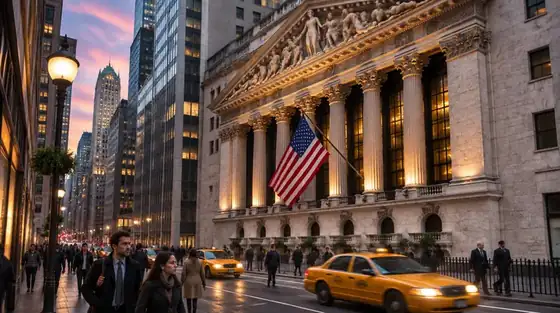
One of the most visible trading questions going into the weekend is not whether the market fell on Friday. It is whether the next regular US session could bring a deeper slide. A November 20 r/wallstreetbets thread titled ‘Are we setting up for a Black Monday?’ had more than 3,800 visible votes when checked. That is a snapshot of one Reddit discussion, not an indicator of future price direction, a representative investor survey, or evidence of a coordinated market view.
The market damage is independently documented. Associated Press reported that the S&P 500 finished Friday 20 November at 6,910.39, down 3.7% on the session and 8.6% over the week. The Nasdaq Composite closed at 22,617.73, down 5.3% for Friday and 10% for the week. The Dow closed at 48,147.33, down 1.9% that day. Reuters reported that the S&P 500 and Dow were more than 10% below their recent closing peaks, the technical definition of a correction. These are completed-session values, not live Monday prices.
Why this matters beyond the headline
Some Reddit replies connect the weakness to the Anthropic initial public offering, Nvidia’s sharp decline, stretched AI valuations, portfolio de-risking and rising fears about rates. Reuters separately documented the AI-led technology selloff and broad market pressure. But the discussion does not establish that one IPO, one institution, or one piece of news must cause Monday’s next move. Calling a crash inevitable from a weekend sentiment post would confuse a narrative with market evidence.
Why Friday’s breadth matters more than a headline
What makes the situation interesting is the contrast beneath the index. Reuters reported that investors had been shifting attention toward value-oriented shares even as growth and technology stocks suffered. That is a reason to compare the market-cap-weighted S&P 500 with the equal-weighted index, sector ETFs, small caps and credit conditions rather than reading a single index candle as the whole market. Divergence between mega-cap technology and the median constituent could make the next session’s breadth more informative than another general ‘AI bubble’ headline.
Asia open: Tokyo is actually closed on Monday
The Asia handover needs precision. Tokyo cash equities will not trade on Monday 23 November because Japan’s Labour Thanksgiving holiday is on JPX’s closure calendar. It would be incorrect to describe a Tokyo opening or closing print that day. If Hong Kong and Shanghai are open on their own exchange calendars, their cash sessions, regional futures and currencies may offer separate risk signals. Futures trading hours are not the same as a cash-market opening auction.
Next comes London. At its 08:00 local open, check how Europe prices the weekend developments, whether major equity sectors fall together, and how sovereign yields and sterling behave. The London close at 16:30 is useful as a handover, not an automatic prediction of the later New York finish. A severe overnight move can reverse or accelerate when US liquidity returns.
What to verify at 9:30 a.m. ET
At the New York cash open at 09:30 Eastern, three checks matter more than a dramatic Reddit headline. First, compare the S&P 500’s verified Friday close at 6,910.39 index points with the new index price; 6,900 is a round-number reference, not a guaranteed support level. Second, distinguish the SPX index from SPY, the tradable ETF quoted in dollars. Third, examine the first 15–60 minutes of breadth, volume and opening-range price action alongside QQQ, IWM, RSP, Treasury yields and the VIX. A large gap by itself does not establish continuation.
Two scenarios, neither a prediction
Two competing scenarios deserve attention. A rebound that broadens beyond a handful of megacap stocks, holds its opening range and attracts sustained volume would contradict the simplest ‘everything is still breaking’ narrative. Conversely, a weak bounce followed by fresh selling across equal-weight sectors, small caps and credit-sensitive assets would give stronger evidence of continued risk aversion. Neither scenario has a preassigned probability. No single indicator determines which will happen.
The practical takeaway is to arrive at Monday’s session with dated levels, a verified holiday calendar and an independent view of market breadth, not a viral prediction. The original Reddit discussion is useful because it captures the question people are asking. An answer worth reading must also explain what facts would prove or disprove the fear.
Sources and further reading
Reddit r/wallstreetbets — Are we setting up for a Black Monday? (20 Nov 2026) ↗Reddit r/Daytrading — What are day traders thinking about this dip? (20 Nov 2026) ↗Associated Press — How major US stock indexes fared Friday 20 Nov 2026 ↗Reuters — Wall Street ends lower on AI selloff and correction (20 Nov 2026) ↗Reuters — AI technology rout prompts shift to value stocks (20 Nov 2026) ↗Japan Exchange Group — official holiday-trading calendar, including 23 Nov 2026 ↗NYSE — trading hours and trading calendar ↗Published Sat, 21 Nov 2026 20:50:00 GMT. This article used AI-assisted drafting. Figures refer to the dates in the text.